
Unlocking Ongoing Revelation: Why the Bible Supports More Scriptures and Prophets Today

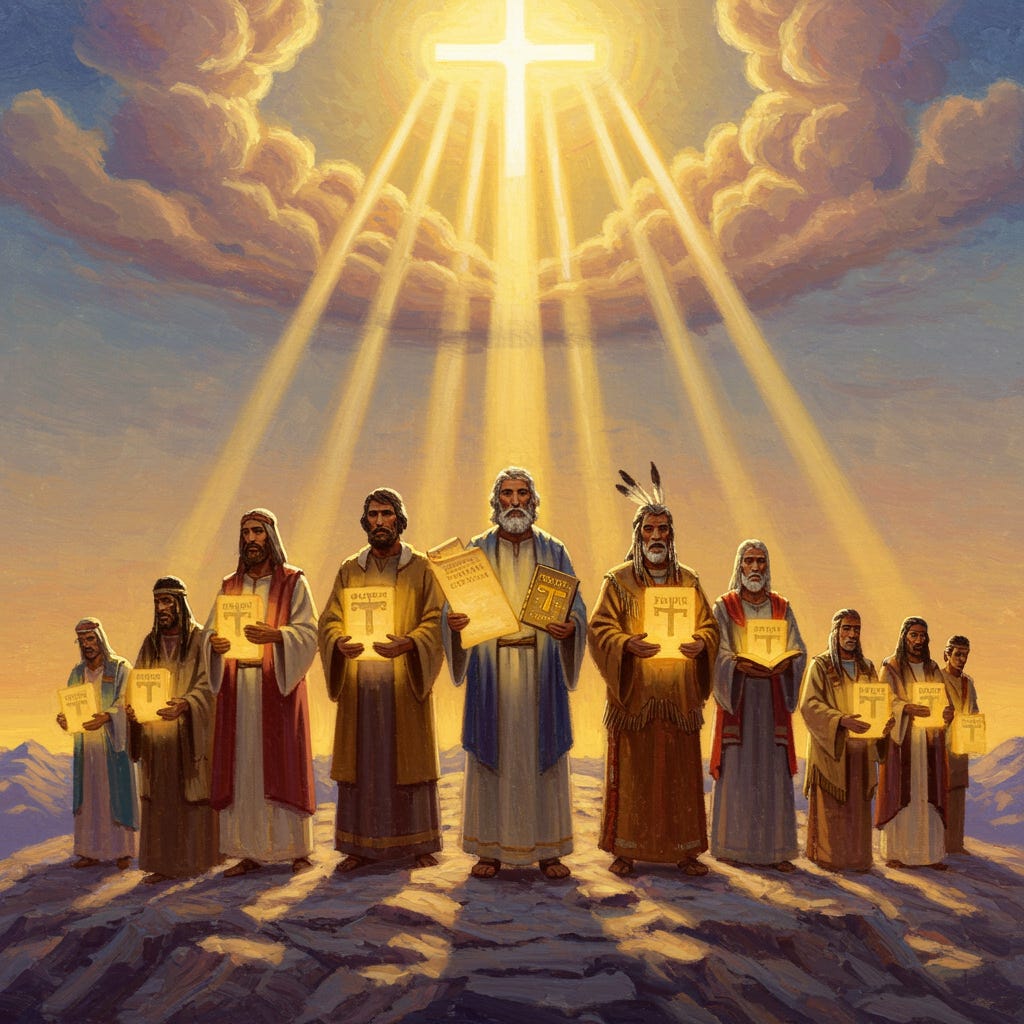
The Bible, revered by billions as the word of God, stands as a profound collection of ancient writings that chronicle humanity’s interactions with the divine. Yet, nowhere within its pages does it explicitly declare itself to be the complete and final repository of God’s revelations. In fact, the very structure and history of the Bible—compiled over centuries from the words of multiple prophets, oral traditions, and diverse texts—undermines the notion that it is, or ever will be, the sole scripture. This compilation process, involving councils, translations, and selective canonization, reflects a dynamic interplay of human and divine elements, suggesting that God’s communication with humanity is not confined to a single volume. Instead, it invites the possibility of continued prophetic guidance and additional sacred writings, aligning with the Bible’s own teachings on an unchanging God who calls prophets across time and peoples.
Consider the Bible’s origins: It emerged not as a monolithic text but as a mosaic of narratives, laws, prophecies, and epistles gathered from various sources. The Old Testament draws from Hebrew traditions spanning over a millennium, while the New Testament compiles letters and gospels from early Christian communities. This evolutionary assembly, formalized in councils like those of Nicaea and Trent, mirrors how God has historically revealed truth progressively through prophets. If the Bible were intended as the ultimate authority, one might expect an explicit divine decree within it affirming its completeness—yet no such statement exists. Rather, passages like Revelation 22:18-19 warn against adding or subtracting from “this book,” often misinterpreted as referring to the entire Bible, but contextually limited to the Book of Revelation itself. This absence of a self-proclaimed finality, combined with the Bible’s prophetic heritage, counters the argument that it alone constitutes God’s word.
Delving deeper into biblical teachings, the pattern of God calling prophets is unmistakable and enduring. From Moses to Malachi in the Old Testament, and from John the Baptist to the apostles in the New, prophets serve as conduits for divine revelation, their words becoming scripture. Amos 3:7 declares, “Surely the Lord God will do nothing, but he revealeth his secret unto his servants the prophets.” This principle underscores that God’s method of communication is through chosen individuals, not static texts alone. The New Testament reinforces this: Ephesians 4:11-13 lists prophets among the offices given “for the perfecting of the saints...till we all come in the unity of the faith,” implying their role continues until Christ’s return. Hebrews 13:8 affirms, “Jesus Christ the same yesterday, and to day, and for ever,” extending to God the Father an unchanging nature (Malachi 3:6). If God called prophets anciently, He does so today and will tomorrow, ensuring revelations adapt to humanity’s needs until the Second Coming.
This ongoing prophetic call naturally leads to additional scripture. The Bible itself anticipates more words from God. In John 21:25, it notes that “even the world itself could not contain the books that should be written” of Jesus’ acts, hinting at unrevealed truths. Revelation 10:4 describes sealed utterances not written, suggesting future disclosures. These elements portray scripture as expansive, not exhaustive.
Further, the Bible addresses God’s covenant people scattered across the earth, described as “other sheep” not of the Judean fold. Jesus states in John 10:16, “And other sheep I have, which are not of this fold: them also I must bring, and they shall hear my voice; and there shall be one fold, and one shepherd.” This prophecy points to dispersed groups, such as the lost tribes of Israel (Isaiah 49:6; Jeremiah 31:10), whom God would guide through prophets, producing their own records. These scriptures would echo core Gospel truths—faith, repentance, baptism, the Holy Ghost—while chronicling unique histories, fulfilling Ezekiel 37:16-17’s vision of sticks (scrolls) of Judah and Ephraim uniting.
Latter-day Saint (LDS) teachings amplify this thesis. The Book of Mormon, another testament of Jesus Christ, affirms that God speaks to all nations: “Know ye not that there are more nations than one?...I speak the same words unto one nation like unto another.” (2 Nephi 29:7-8). It identifies the “other sheep” as ancient Americas’ inhabitants visited by Christ (3 Nephi 15:21-24), whose records complement the Bible. Doctrine and Covenants emphasizes continuing revelation: “We believe all that God has revealed, all that He does now reveal, and we believe that He will yet reveal many great and important things pertaining to the Kingdom of God” (Articles of Faith 1:9). Joseph Smith’s revelations, like Doctrine and Covenants 1:38, declare God’s voice ongoing: “What I the Lord have spoken, I have spoken...whether by mine own voice or by the voice of my servants, it is the same.” This aligns with biblical patterns, extending prophetic authority beyond antiquity.
Apocryphal works further support this view. In 2 Esdras 14, God commands Ezra to rewrite lost scriptures, producing 94 books: 24 for public canon (the Hebrew Bible) and 70 esoteric ones for the wise. This narrative endorses additional revelations beyond the standard canon, reflecting God’s provision for ongoing truth. The Book of Enoch, influential on New Testament writers, contains prophecies and visions extending divine narrative, with Jude 1:14-15 quoting it directly. Such texts illustrate that sacred writings have historically expanded, countering closed-canon claims.
The Nemenhah Records, purporting to be ancient Native American scriptures from descendants of Book of Mormon peoples (stemming from Hagoth’s migrations in Alma 63), exemplify this pattern. These records describe a people guided by the Holy Ghost (“Nemenhah” meaning “The People guided by the Holy Ghost”),1 with continual prophets and revelations. They mention interactions with Book of Mormon-era figures like the Three Nephites (3 Nephi 28), and emphasize God raising prophets among all nations: “For does He not raise up prophets unto all nations?”2 Teachings on communal living, healing, and spiritual communion mirror Gospel principles while detailing unique histories, such as migrations and visions. As “other sheep,” the Nemenhah’s scriptures reinforce unified truths across folds, anticipating a gathering before Christ’s return.
In conclusion, the Bible’s silence on its own finality, its prophetic legacy, and its prophecies of scattered sheep all point to a God who continues to reveal through prophets, generating additional scriptures. This thesis not only honors the Bible but expands its scope, inviting all to seek living waters from an eternal source. As Hebrews 1:1-2 notes God’s past communications through prophets and His Son, the unchanging divine nature ensures such revelations persist until unity is achieved at the Second Coming.
“The Nemenhah Records,” Reluctant Watchman, last modified January 1, 2023, https://www.reluctantwatchman.com/nemenhah-records.
“The Mentinah Archives,” Plates of Mormon, accessed February 24, 2026, https://platesofmormon.files.wordpress.com/2008/04/volume3.pdf, chapter 5.