
The Wounded Gladiator: Why Compassion Beats Combat Online

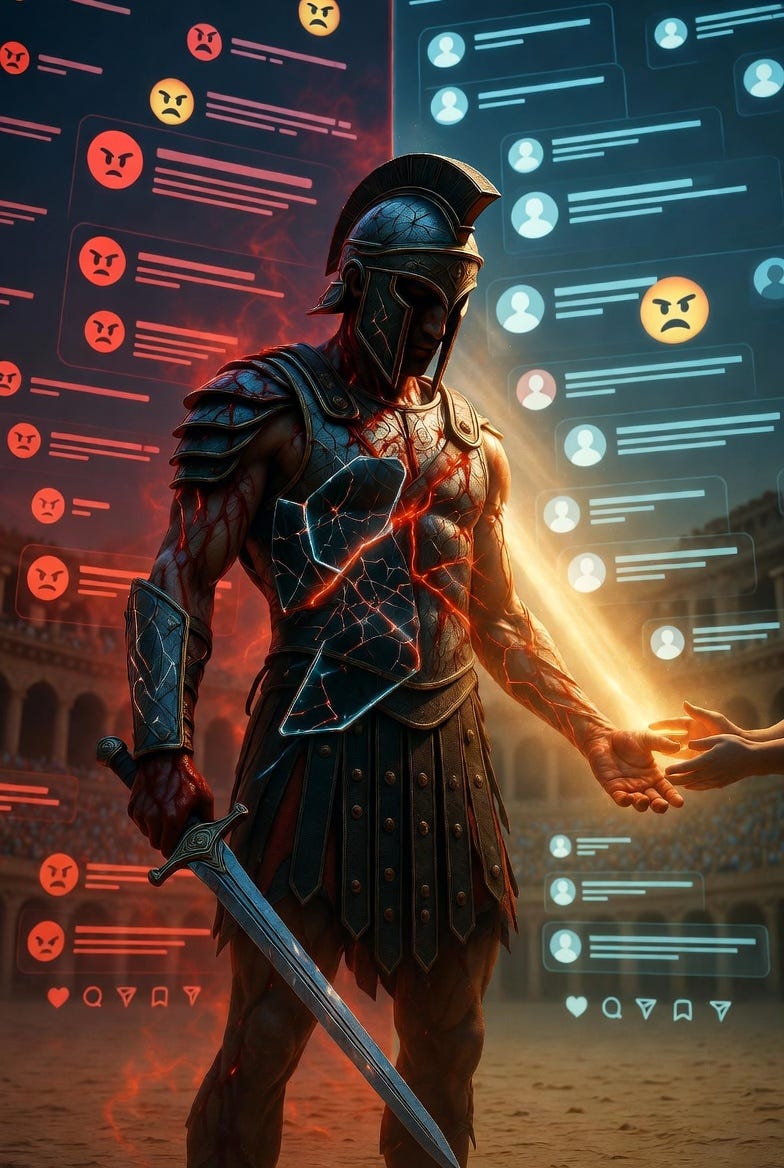
In the vast digital coliseum of social media, where every scroll delivers another gladiator into the arena, we often encounter a particular figure: the combatant whose every post, reply, and thread pulses with raw, unfiltered conviction. Their arguments rest on foundations of misconception—half-remembered facts, echo-chamber narratives, fear-wrapped certainties. Yet beneath the barrage lies something far heavier: a soul screaming in pain.
This person carries real trauma, the kind that lodges in the body like shrapnel. Fear and self-hate have become constant companions. Their nervous system, battered by past wounds, operates in perpetual fight, flight, or freeze. The prefrontal cortex—the quiet architect of reason, nuance, and pause—has been overwhelmed, its lights dimmed by cortisol floods and survival imperatives. Logic feels like a foreign language when every interaction registers as threat. Emotions surge unregulated, turning disagreement into existential attack. And in this state, they find their tribe: others similarly wounded, offering validation through shared outrage. The group hug of collective grievance becomes oxygen. It fuels them, shields them, confirms that the world is indeed as hostile as they feel.
We see the spectacle and react in kind. We type furiously, dismantle their points with facts and links, raise our own voices in digital thunder. "You're wrong," we declare. "Dangerous, even." We attack back, certain that sharpness will cut through delusion. But watch what happens: our counterfire lands like another wound. It confirms their story—that they are under siege, that outsiders are cruel, that only their circle truly sees them. The cycle tightens. Misconceptions harden into armor. Pain begets pain. Confusion deepens. No one is heard; everyone bleeds.
What if we paused long enough to see the human behind the avatar?
This is not weakness or capitulation. It is clarity. The person before us (or rather, the flickering words on our screen) is not primarily an opponent to defeat but a wounded being in desperate need of safety. Their views are symptoms, not the core. The misconceptions are scaffolding erected around a shattered foundation. Shouting at the scaffolding does nothing to heal the cracks beneath. What they require—what we all require, in our own moments of fracture—is a different approach: compassion as the first response, not the last resort.
Imagine entering the fray not with sword but with a tender ear. Listen past the yelling to the tremor underneath. Offer patience that holds space without collapsing into agreement. Extend forgiveness that acknowledges their pain without excusing harm. Speak truth, yes—gently, persistently, from a place of genuine curiosity rather than conquest. "I hear how much this hurts you. Tell me more about where that fear comes from." Such words risk nothing but our own ego. They model the regulation the other lacks. They signal safety: You do not need to fight me to be seen.
This is not easy. It demands we regulate our own nervous systems first, resisting the dopamine hit of righteous clapback. It asks us to remember that behind every toxic thread is a story of survival, however maladaptive. Some wounds run so deep that healing feels impossible without professional help, community care, time, and grace. Social media is rarely the place for full repair, but it can be a place where we refuse to add to the injury.
In choosing compassion over combat, we break the cycle not by winning the argument, but by refusing to play the game that keeps everyone trapped. We affirm that humans are not ideas to be destroyed but beings to be understood. The misconceptions may linger. The trauma may take years to soften. Yet in small acts of patient presence, something shifts: a crack of light in the armor, a momentary exhale, the faintest possibility that not every interaction must end in more pain.
We cannot heal the world one troll at a time. But we can choose, in this moment, not to become another wound in someone's already heavy story. That choice, quiet as it is, may be the most radical thing we post all day.